Let me tell you something I have never seen written in a writing course, a craft book, or a YouTube tutorial aimed at first-time authors. Authors wanting to write their first book.
The reason your book is still in your head has nothing to do with your ability to write it.
I want you to sit with that for a moment before we go any further. Because if you are reading this article, there is a very good chance you have been carrying a story for longer than you want to admit. Maybe two years. Maybe five. Maybe it surfaces every January when you decide this is finally going to be the year. Maybe it shows up at two in the morning when the house is quiet and your brain hands you a scene so vivid and complete that you think — I have to write this down. And then morning comes, and life comes with it, and the document stays blank, and the story goes back to wherever it lives inside you until next time.
You have probably told yourself the same story about why. You are not disciplined enough. You are not ready. You do not have enough time. The idea is not fully formed yet. You need to do more research. You need to read more books about writing before you start writing your own.
I am going to tell you something as someone who has published over 20 titles across fiction, faith, writing craft, Biblical studies, and children’s books. None of those are the reason. Not one of them.
The reason your book is still in your head is that nobody ever showed you what a finished book actually requires. And you cannot build something when you do not know what it is supposed to look like when it is done.
That is what we are going to fix today.
First. Let’s Talk About What A Book Actually Is.
Most first-time authors think about their book in terms of the story. The characters. The message. The chapters they can already see playing out in their mind like a film. And that is right — that is the heart of it. But a book is not just a story. A book is a structure that carries a story. And the structure has specific components that every professional manuscript requires, in a specific order, for specific reasons that most writing courses never bother to explain because they assume you already know.
You do not know because nobody taught you. That is not a character flaw. That is a gap in the information that was available to you. Today we close it.
A book — any book, fiction or nonfiction, faith-based or secular, memoir or fantasy — is built in two parts. The front matter and the back matter. Everything in between is your story. But the front matter and the back matter are what separate a professional manuscript from a document that announces to every reader who opens it that this is someone’s first attempt.
Let me walk you through both.
The Front Matter — Everything Before Chapter One
The front matter is the collection of pages that live at the beginning of your book before your story begins. Most first-time authors either skip these entirely, put them in the wrong order, or fill them with content that does not match what that section is supposed to do. Here is what belongs there and what each one actually means.
The Title Page
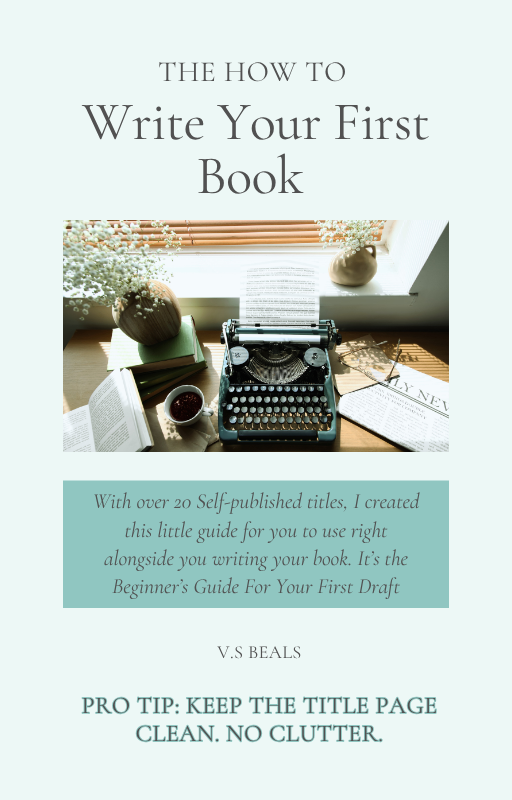
This is the first page a reader sees inside your book after the cover. It carries your title, your subtitle if you have one, and your name. That is it. Nothing else. No taglines. No quotes. No author bio. No decorative paragraph explaining what the book is about. The title page is clean by design. Its job is to state plainly what the reader is holding and who wrote it. The moment you clutter it you signal that you are new to this. Keep it clean. Keep it simple. Let the title do the work it was designed to do.
The Copyright Page
This is the page most first-time authors either skip entirely or fill incorrectly, and it is the page that matters most legally. Your copyright page establishes your ownership of the work. It should include your copyright symbol and year, an all rights reserved statement, your publication information including city and country, your edition and publication date, your ISBN if you have one, your cover designer credit, your editor credit if applicable, your contact information or website, and your disclaimer — which for fiction states that names, characters, places, and incidents are either the product of the author’s imagination or are used fictitiously.
I know that sounds like a lot. It is not as complicated as it looks written out. But it matters. A reader who flips to your copyright page and finds it blank or half-filled loses a degree of trust in the professionalism of what they are holding before they have read a single sentence of your story.
The Dedication Page
This is one of the shortest pages in your book and one of the most powerful. A dedication is not an acknowledgment. I want to make that distinction clearly because first-time authors confuse these two sections constantly. A dedication is a single sentence — sometimes a single name — that tells the reader who this book was written for or written in honour of. It is intimate. It is brief. It can be sweet or funny or cryptic. It can be for your mother or your child or the version of yourself that almost gave up. There are no strict rules except one — keep it short. One sentence is enough. Two is plenty. A paragraph is too long. If you want to thank everyone who helped you bring the book to life, that belongs in the acknowledgments. The dedication belongs to one person or one moment and it carries more weight when it is given room to breathe.
The Foreword, The Preface, and The Introduction
These three sections are different things and they do not all belong in every book. Understanding the difference will save you from including sections that slow your reader down before your story has even started.
A foreword is written by someone other than you — typically a respected voice in your field, a fellow author, or someone whose endorsement lends credibility to your work. Its purpose is to build trust with the reader before they begin. For most first-time authors, a foreword is rare and not required. Do not stress about this one.
A preface is written by you. Its purpose is to explain why you wrote the book — what inspired it, what you went through to write it, what you hope it does in the reader’s life. Some readers love a preface. Many will skip it. If you include one keep it to two or three paragraphs and make it compelling enough to read on its own. If it reads like an apology for the book that follows, cut it.
An introduction is also written by you but its purpose is different from a preface. Where a preface is personal, an introduction is contextual. It gives the reader background information that will help them understand what they are about to read. In fiction this is rarely necessary and often works against you — readers would rather dive straight into chapter one than sit through an explanation of the world they are about to enter. If your story works without an introduction, let chapter one do the work.
The bottom line on all three — they can add value in the right circumstances but they are not essential. For most first-time fiction writers the strongest opening you can give a reader is a prologue that hooks them or a first chapter that pulls them in immediately. Trust your story.
The Prologue
The prologue is the section that most first-time authors either misuse or skip because they do not understand what it is actually for. A prologue is a scene or passage that lives before chapter one. It is not the beginning of your story — it is the doorway into it. A strong prologue does one of three things. It creates tension that drives the reader into chapter one needing answers. It introduces a moment that exists outside the main timeline of the story but casts light on everything that follows. Or it raises a question so compelling that the reader cannot put the book down without knowing the answer.
What a prologue is not — an information dump. It is not the place to explain your world, your characters, your backstory, or your themes. The moment a prologue starts explaining rather than pulling, the reader disengages. If your prologue could be summarised as backstory, it is not a prologue. It is an introduction in disguise and it belongs cut.
The rule of thumb I give every writer I work with is this — if your story works without the prologue, let chapter one carry the weight. But if there is a moment that exists outside your main narrative, a whisper before the story shouts, a question that makes the reader grip the pages before the story has technically begun — that is where your prologue lives.
The Back Matter — Everything After Your Story Ends
The back matter is the collection of pages that live at the end of your book after your final chapter. Most first-time authors treat these pages as an afterthought. They are not. Done correctly, the back matter is one of the most powerful tools you have for building a readership that follows you from one book to the next.
The Epilogue
An epilogue is a final scene that takes place after your main story has ended. It is not a new chapter. It is a closing image — a quiet answer to the question the reader is still holding as they turn the last page. Think of it as the last word in a long conversation. It should feel final without feeling abrupt. It should give the reader closure without closing every door. Keep it brief. One to three paragraphs. Let it land softly and then let go.
The Afterword
An afterword is written by you, the author, speaking directly to your reader after the story is complete. It is not fiction. It is a conversation. Why you wrote this book. What it cost you. What you hope stays with them when they put it down. Readers who reach the afterword finished your book. They are not ready to leave yet. They are looking for you — not the narrator, not the character, but the person who sat alone and wrote this thing. Meet them there. Be honest. Be brief. Sign your name.
The Acknowledgments
The acknowledgments page is where you thank the people who helped bring your book to life. Editors. Beta readers. The friend who read the terrible first draft and told you the truth anyway. The family member who covered for you so you could write. God, if you are a person of faith and this story came from somewhere beyond yourself. The acknowledgments should feel genuine. They should not feel like a resume of every person you have ever met. One or two paragraphs is enough. Lead with the people who directly touched the manuscript. Use your natural voice. It does not have to be formal. It has to be true.
The About the Author Page
This is the page that turns a reader into a follower. Your about the author section introduces you to the person who just finished your book — which means they already trust you enough to have read to the end. That is a warm audience. Do not waste it on a formal biography written in the third person that reads like a LinkedIn profile.
Two to five sentences. Your genre. One personal detail that makes you human. Your platform — where they can find you, follow you, and eventually buy the next book. That is all you need. Keep it conversational. Write it the way you would introduce yourself to someone who just told you they loved your work.
The Bonus Pages
Bonus pages are optional back matter that add value for specific readers. A sneak peek of your next book. Discussion questions for book clubs. A glossary or pronunciation guide for fantasy or complex world-building. These are not filler — each one serves a purpose. Only include what genuinely enriches the reading experience. Back matter that feels padded signals to the reader that you ran out of story before you ran out of pages. Back matter that feels intentional signals that you have more to give.
The Part Nobody Talks About — The Blank Page Problem
Here is the thing about everything I just taught you. Reading it is one thing. Implementing it is another. Because knowing what a copyright page requires does not give you a formatted copyright page. Knowing what a prologue is supposed to do does not give you a prologue page with the right layout and the right space to write inside it.
This is the second gap. Not the knowledge gap — we just closed that one. The structural gap. The absence of a framework to build inside.
I spent years figuring out what a professional manuscript looks like from the inside out. Every section I just walked you through is a section I had to learn the hard way, often by publishing a book and realising after it was in print that something was missing or misplaced or formatted incorrectly. Over 20 titles later I have a very clear picture of what a first-time author actually needs before they type a single word of their story.
They need the knowledge of what goes where. And they need somewhere to put it.
If you are serious about starting your book and you want something that takes you from this article into the actual building of it, the link is below.
Everything covered in this article — the front matter, the back matter, the chapter structure, all of it — I turned into two things you can use today.
Done-For-You Canva template — no Pro subscription needed, just a free account — where every section is already built and waiting for your story. You open it and you write.
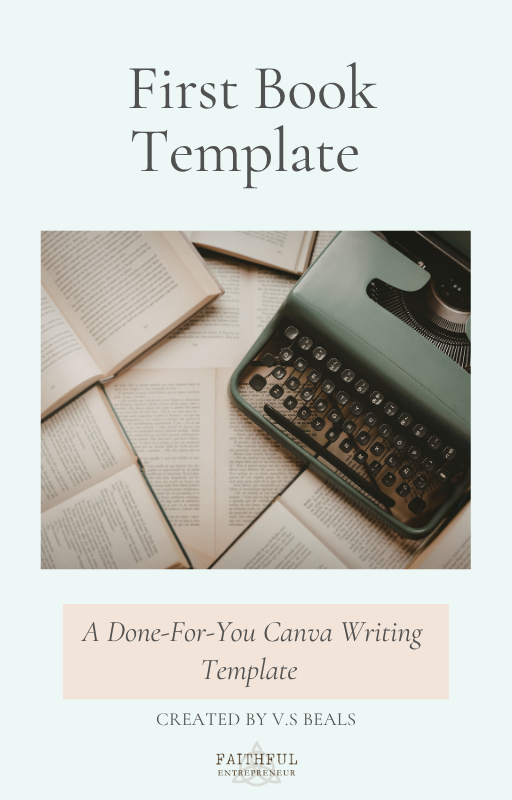
Not looking for a Done-For-You Template and prefer a Guide that walks you through every section of your manuscript so you always know what goes where and why. Grab all your First Book answers below at link
The Last Thing I Want To Leave You With
I want to say one more thing before you close this article. And I want to say it plainly because I think you need to hear it.
Your book is not late. It is not evidence of a lack of discipline or talent or calling. It has been waiting for the right structure to arrive so it could finally exist in the world.
Proverbs 16:3 says commit your works to the Lord and your thoughts will be established. Not your outline. Not your word count goal. Your works. The actual building of the thing. The showing up. The writing badly on a Tuesday because Tuesday was the day you had. That is the obedience. That is where the establishment happens — not in the planning, in the doing.
The story in your head was placed there for a reason. The person it is written for does not know your name yet. They are out there right now looking for the exact words you are holding back.
The structure is here. The framework is built. The only thing left is for you to begin.
Go write your book.
Stay faithful, stay discipline, and stay loyal.
With love and fire,
V.S. Beals
Writer. Watchwoman. Woman of the Word.
Have You Read Last Week’s Article
Follow Me on Pinterest
Follow Me on My WriterTok Where I Upload Daily Tips